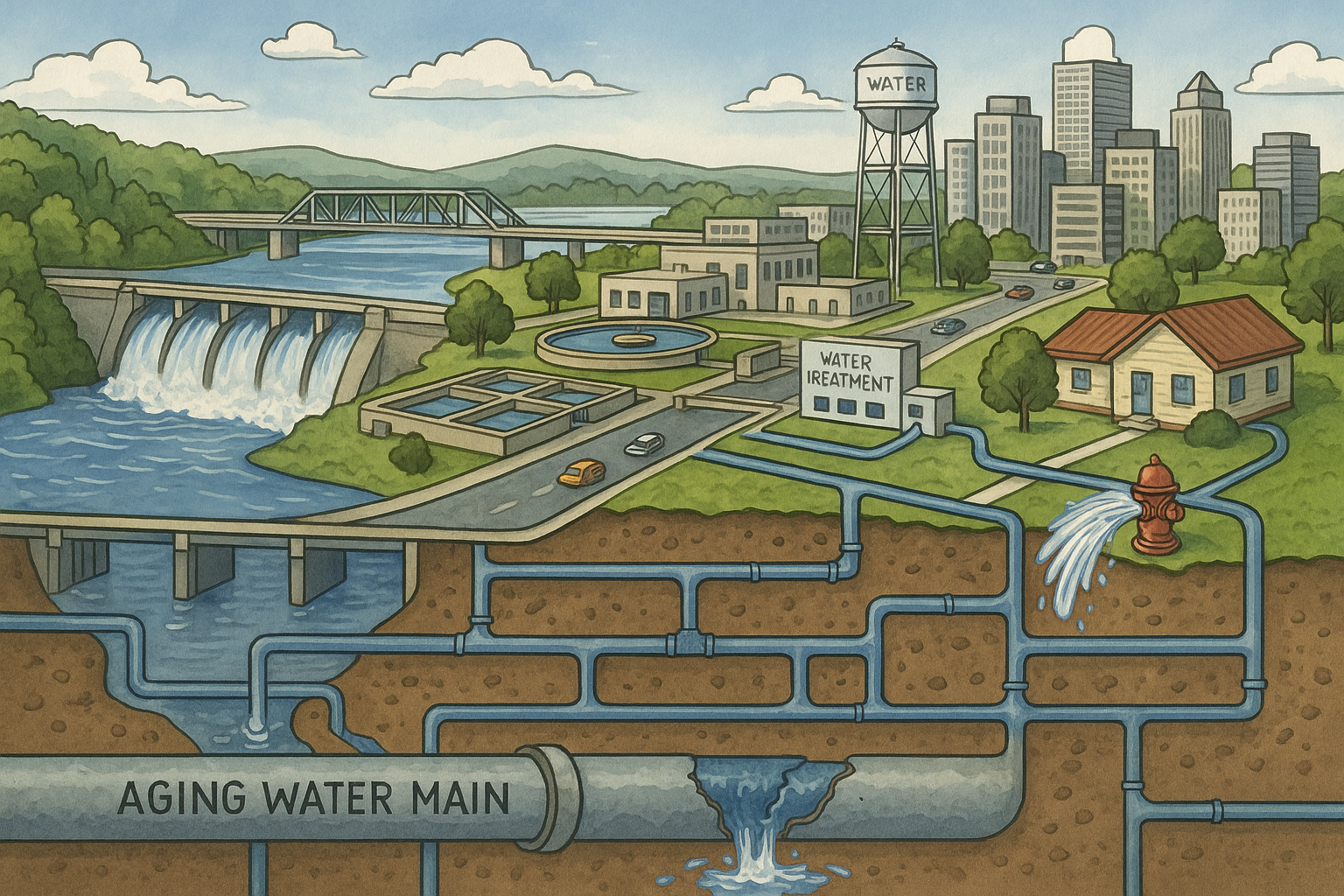
Turn on a faucet, and clean water flows. Flush a toilet, and waste disappears. For most Americans, water infrastructure is invisible—until it fails. And fail it does, with alarming frequency. From lead contamination in Flint to water main breaks in cities across the nation, America’s water systems are sending urgent distress signals that we can no longer ignore.
The Crisis Beneath Our Feet
America’s water infrastructure is old. Really old. Many cities still rely on pipes installed during the Industrial Revolution—some dating back to the 1800s. The Environmental Protection Agency estimates that:
- There are 240,000 water main breaks annually, wasting over 6 billion gallons of treated water
- The average water main is 45 years old, with some pipes over a century old
- Approximately 10 million homes still receive water through lead service lines
- Water systems need $625 billion in investment over the next two decades
For wastewater, the picture is equally concerning:
- Aging sewer systems experience 850 billion gallons of overflow annually, contaminating waterways
- Combined sewer systems in older cities discharge untreated sewage during heavy rains
- Treatment plants built 40-50 years ago are reaching the end of their useful lives
- Wastewater infrastructure needs $271 billion in investment
The Health Imperative
Unlike repairs for roads and bridges, where failure means inconvenience, water infrastructure failure means public health emergencies. The crisis in Flint, Michigan, where lead contamination exposed thousands of residents to toxic water, exemplifies the human cost of neglecting water systems.
But Flint isn’t unique. The Natural Resources Defense Council identified more than 5,000 water systems serving millions of Americans that violated the Lead and Copper Rule. Aging infrastructure also contributes to:
- Waterborne disease outbreaks
- Chemical contamination from corroded pipes
- Cross-connections during low pressure events
- Boil water advisories that disrupt communities
Clean, safe water isn’t a luxury—it’s a fundamental human right and a prerequisite for public health.
The Economic Impact
Water infrastructure problems carry significant economic costs:
Business Disruption: Water main breaks and service outages disrupt businesses, costing the economy billions annually.
Property Damage: Main breaks damage roads, buildings, and other infrastructure, creating cascading repair costs.
Economic Development: Communities with unreliable water systems struggle to attract businesses and residents.
Tourism and Recreation: Sewage overflows close beaches, contaminate fishing areas, and damage reputation.
Agricultural Impact: Farmers depend on reliable, clean water for irrigation and livestock.
The American Water Works Association estimates that failure to invest in water infrastructure could cost the U.S. economy $3 trillion in lost GDP over the next 20 years.
The Funding Challenge
Water infrastructure traditionally relies on local financing—utility rates, municipal bonds, and state revolving loan funds. But this model faces serious challenges:
Aging Demographics: In many communities, shrinking populations spread costs across fewer ratepayers.
Affordability Concerns: Low-income households already struggle to pay water bills. Rate increases face political resistance.
Deferred Maintenance: For decades, many utilities have kept rates artificially low by deferring maintenance, creating a backlog of needs.
Climate Adaptation: Extreme weather events from climate change are overwhelming systems designed for historical conditions.
Regulatory Requirements: Stricter water quality standards require expensive treatment upgrades.
The EPA estimates that current spending levels meet only about 70% of water infrastructure needs, leaving a funding gap of billions annually.
Enter Private Capital
Historically, water infrastructure has been primarily public. But facing massive investment needs and limited public resources, many communities are turning to private capital through various models:
Regulated Private Water Companies: In some states, private water companies operate under public utility commissions, serving millions of customers.
Public-Private Partnerships: Cities partner with private operators who bring capital and expertise while the municipality retains ownership.
Contract Operations: Private companies operate public systems under management contracts, often improving efficiency without changing ownership.
Infrastructure Funds: Specialized investment firms acquire and upgrade water systems, viewing them as long-term infrastructure investments.
American Infrastructure Partners and similar firms have identified water infrastructure as an attractive investment class, offering stable, regulated returns while addressing a critical societal need. These investors bring not just capital but also operational expertise, technology, and professional management to struggling systems.
Innovation and Technology
Modernizing water infrastructure isn’t just about replacing old pipes—it’s about incorporating new technologies:
Smart Water Networks: Sensors and meters detect leaks, monitor quality, and optimize pressure in real-time, reducing water loss by up to 40%.
Advanced Treatment: New technologies remove emerging contaminants like PFAS, pharmaceuticals, and microplastics.
Asset Management Systems: Data analytics help utilities prioritize repairs and replacements based on condition and criticality.
Trenchless Technology: New installation methods minimize disruption and cost when replacing pipes.
Water Reuse: Advanced treatment makes wastewater suitable for irrigation, industrial uses, or even potable consumption.
Green Infrastructure: Natural systems like wetlands and bioswales manage stormwater while providing environmental benefits.
These technologies require upfront investment but deliver long-term savings through efficiency, reduced maintenance, and improved reliability.
Environmental and Climate Considerations
Water infrastructure must adapt to changing environmental conditions:
Drought Resilience: Western states need diverse water supplies—desalination, water reuse, and improved storage.
Flood Management: Coastal and riverside communities need infrastructure that can handle more frequent extreme weather.
Energy Efficiency: Water treatment and distribution consume significant energy. Efficiency improvements reduce both costs and carbon footprint.
Ecosystem Protection: Reducing sewage overflows and improving stormwater management protects rivers, lakes, and coastal waters.
Groundwater Sustainability: Preventing over-pumping and contamination protects future water supplies.
The Path Forward
Addressing America’s water infrastructure crisis requires a comprehensive approach:
Increased Federal Investment: Recent infrastructure legislation provides significant funding, but sustained commitment is needed.
State and Local Investment: Communities must charge rates that cover full lifecycle costs, not just operations.
Private Capital: Strategic use of private investment can accelerate improvements while maintaining public accountability.
Asset Management: Systematic assessment and planning help prioritize investments for maximum impact.
Regulatory Support: Streamlined permitting and flexible regulations can reduce costs without compromising safety.
Workforce Development: Training the next generation of water professionals to operate increasingly sophisticated systems.
Affordability Programs: Ensuring low-income households maintain access to clean water even as rates rise to cover infrastructure costs.
Why This Matters
Water infrastructure lacks the visibility of highways or airports. It’s buried underground, largely forgotten until something goes wrong. But it’s arguably our most critical infrastructure system. Humans can survive without many things, but not without clean water.
Every day we delay investing in water infrastructure, the problems worsen and the costs increase. Pipes don’t improve with age. Treatment plants don’t magically upgrade themselves. The only question is whether we’ll pay now for planned improvements or later for emergency repairs and public health crises.
Conclusion
America’s water infrastructure crisis represents both a challenge and an opportunity. The challenge is clear: billions of dollars in investment needed to replace aging systems, meet modern standards, and adapt to climate change.
The opportunity is equally clear: creating safe, reliable water systems that protect public health, support economic growth, and preserve our environment for future generations. It’s also an opportunity for innovative financing models, new technologies, and creative partnerships between public and private sectors.
Water is life. The infrastructure that delivers it deserves to be America’s highest priority. The investment required is substantial, but the value—measured in health, prosperity, and sustainability—is beyond calculation.
It’s time to bring our water infrastructure out of the shadows and into the light. Our health, our economy, and our future depend on it.